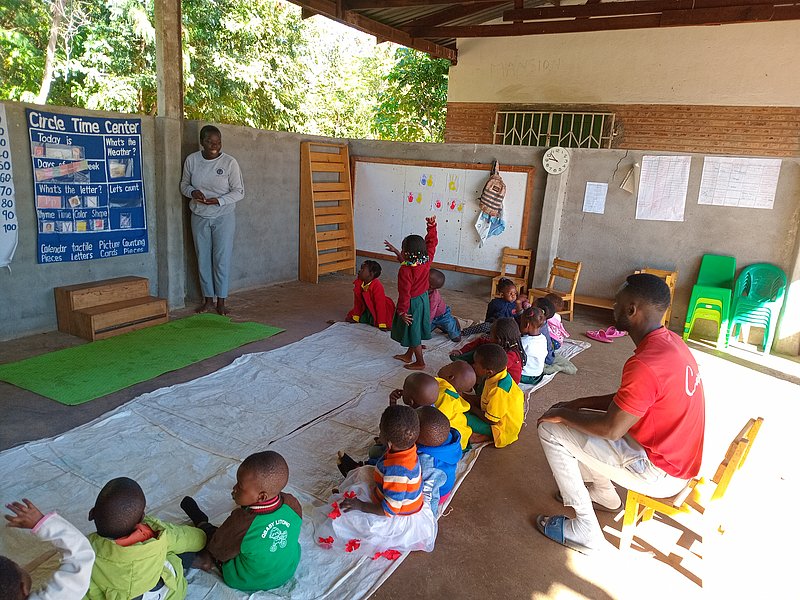
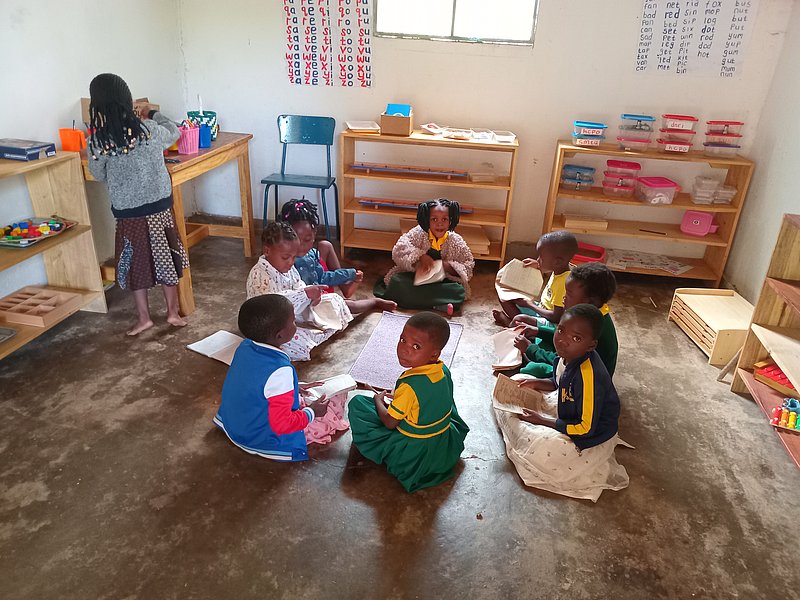
What is the educational theory behind Montessori pedagogy?
It focuses on the child. The environment is suitable for children’s needs and encourages them to discover, to experiment and to learn. The material available is tailored to that purpose. In this way children learn to be independent and enjoy learning. They find out how to push themselves to the limit, to overcome obstacles, to make mistakes and to learn from their mistakes.
Malawi: Learning for life, faith for the heart
Montessori preschool on the Balaka farm
In the remote villages of Malawi, the concept of a kindergarten is not widely accepted. In this interview with Julia-Kathrin Raddek, missionary Karin Schwarz explains how a Montessori nursery school was successfully established on Balaka Farm despite these challenges, and what added value it brings to the local community.
Julia-Kathrin Raddek: When was this kindergarten established and how many people work there? How many children attend?
Karin Schwarz: The kindergarten opened in 2022. At that time, there were seven to eight children and two specially trained Montessori educators. The start was not easy. The value of early childhood education was not recognized by the general village population. The first educators therefore left the facility in frustration. Now David is working there. He's a certified Montessori teacher and can also train apprentices. Today, there are four people working at the kindergarten: two trained educators (one man, one woman) and two trainees. By 2024, the number of kids had grown to 55, which makes me and everyone else really happy.
JKR: That's very good to hear! Can you say what led to the increase in numbers?
KS: The first children who attended the kindergarten and then switched to the village school showed significantly better results. They were able to understand English and had a different learning strategy. Parents noticed that the Montessori concept works. Besides we did some advertising: we drove through the streets in a car equipped with children's music and a megaphone and explained to people what the kindergarten costs and what it offers.
JKR: The majority of people in Malawi earn less than 80 euros a month. How much does it cost to attend kindergarten at your facility?
KS: We charge around 3,000 to 10,000 kwacha (about €1.50 to €5) per month, depending on the parents' income. Wealthier parents initially asked us to offer an “elite kindergarten” and were opposed to poorer children attending. In addition, the general population tends to believe that raising children involves drill and memorization. Freeplay and independent discovery are not part of this. We had to talk a lot with the parents and “kings” (local authorities, roughly comparable to a mayor) to explain to them that the kindergarten should enrich the entire community and be open to everyone. Most of them now understand the concept.
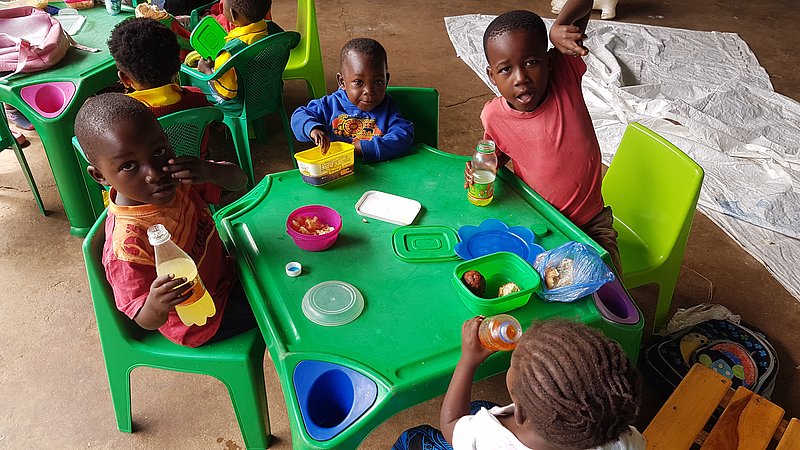
JKR: How does the kindergarten specifically serve people?
KS: It helps particularly vulnerable girls who have had children at the age of 15 and therefore had to drop out of school. They can bring their children to our kindergarten and at the same time receive training on the farm. In this way, the kindergarten is gradually changing the rural population's attitude toward early childhood education. In addition, the state ensures that all children are vaccinated regularly by sending health teams to the farm. This is particularly valuable because otherwise the children would not be vaccinated at all.
JKR: To what extent is the Balaka Farm concept reflected in the educational approach?
KS: The Montessori curriculum includes topics such as nature, bees, trees, flowers, and vegetables, which fits perfectly with the farm. The children plant beds and water them. They take regular walks on the farm, learn about the cycle of nature, and enjoy the greenery. They can't experience any of this in the villages. They also learn to appreciate ripe fruit, because at home most of them harvest unripe fruit for fear of not getting anything else.
JKR: How is the Christian faith passed on to children?
KS: Faith is firmly anchored in the concept. All staff members are Christians. This is a prerequisite for employment. The children mainly learn Bible songs in English.
JKR: Can you share a special story with us that you experienced in your kindergarten?
KS: Two years ago, a mother with two small children came to us after her husband left her. Her son Happy´s development was retarded and he had comprehension difficulties. Her son Happy had developmental delays and comprehension difficulties. Since the kindergarten was not yet full at that time (7-12 children), Happy was able to receive individual support. He stayed in kindergarten for an extra year for additional preschool training and is now keeping up quite well in elementary school. It was also important to explain to the mother that her child was not being deliberately disobedient, but was slightly retarded. In Malawi, children are often beaten because parents think they are deliberately disobedient. We also involved the grandmother, as the family lives without a father.
JKR: Can the kindergarten be financially independent?
KS: No, the kindergarten can never survive on its own in this poor area. The salaries of the trained educators cannot be covered by the fees alone. It is a mission-oriented kindergarten with trained staff, which is co-financed by donations to the Balaka Farm.
JKR: Thank you very much for your insights, dear Karin!
The interview was first published in EBMI Magazine 3/2025

The Balaka Farm: A place of multifaceted growth
The kindergarten is just one part of the work. At Balaka Farm, young people can undertake a one- to two-year agricultural training programme. Among other things, they gain valuable knowledge about medicinal plants, their uses and how to process them. By living together in a spiritual community, the participants also learn how important it is to have a relationship with God, with themselves, with other people and with nature as God’s creation.