

Population: 19,4 million
Member union: BACOMA (Baptist Convention of Malawi)
Projects in these areas of work:
Children at risk
Church development
Capacity building
Relief work
Health care
Malawi: About the comfort room and planting trees
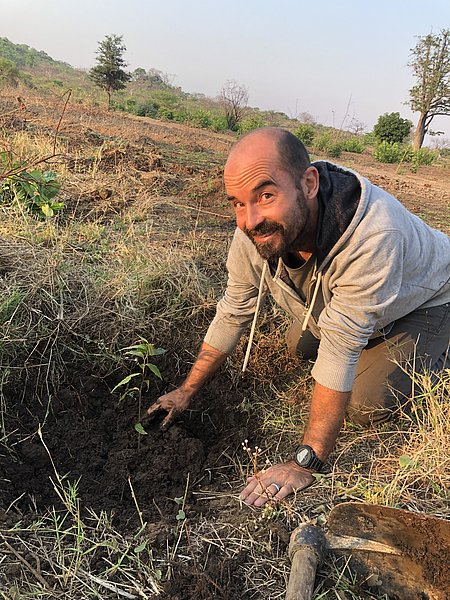
Together with her husband Daniel, Deborah Naujoks spent a year on the Balaka farm in Malawi. They put their skills to good use in various areas and left their mark. In the following, Deborah tells us what planting trees and the daily visit to the toilet have to do with a worthwhile future.
“And if the world should end tomorrow, I'll plant a tree today.”
When I was a little girl, a poster with this quote from Martin Luther was stuck on our toilet door. I read the sentence every time I sat on the toilet. Today, many years later, it comes back to me. My article will combine two themes: Planting trees and going to the toilet. What do these two things have in common? A good question!
Trees for a future worth living
The problems in Malawi are immediately apparent. It is one of the poorest countries in the world. The population is suffering from hunger, the rainy seasons are becoming increasingly unreliable, inflation is taking on grotesque proportions and corruption permeates the entire country. So what to do in the midst of this “doomsday atmosphere”? - Plant trees!
Karin Schwarz and her team have planted well over 5,000 trees on the Balaka farm in recent years. If you look at the area on Google Earth, the farm stands out as a green spot in the middle of the barren, dry wasteland. Trees offer protection, create a pleasant climate even in the scorching heat, provide a habitat for numerous animals, improve soil quality, protect against erosion and some even bear fruit!
In Malawi, where there are hardly any trees left due to heavy deforestation, planting trees is vital for the next generation. The Balaka Farm is an agricultural training farm that trains young Malawians in sustainable agriculture. In addition to practical know-how and a lot of hard work in the fields, they learn above all to have hope. They discover that they are not powerless in the face of fate, but can actively work towards their future - with Jesus in their hearts.
For me, planting trees became a symbol of turning hope into action: To look to the future, but to act in the present. And the fruits are visible! The countless papaya trees produce a sweet harvest every year. In December, the mango trees are hung with large fruits that are just waiting to be eaten. Thanks to the shade provided by the many trees, the vegetables thrive despite the heat. The trees nourish the severely depleted soil with much-needed nutrients.
But what does all this have to do with going to the toilet?
The comfort room – an underrated place
The toilets on the Balaka farm are something special. They consist of two stools, each with a bucket underneath. One is used for the big job, the other for the small job. Full concentration and body control are required here! The urine can be used as liquid fertilizer in a dilution of 1:5. The feces are covered with dry material such as leaves and grass and, when the bucket is full, are placed in a compost pit. Once the pit is full, it is covered with soil, and over the course of about six months, it turns into mature, nutrient-rich compost. When the students plant a tree on the farm, they dig a large hole and fill it with this soil—their “starting capital” for the tree. I find this idea inspiring: our waste becomes starting capital!
With this in mind, I would like to encourage you: No matter what situation you find yourself in, plant a tree (perhaps only figuratively speaking)! Because every small beginning, every act of faith and hope contributes to shape a better future. Our waste, our mistakes, and our weaknesses can become valuable start-up capital for growth, renewal and hope if we entrust them to God.
by Deborah Naujoks
Deborah and Daniel are from Switzerland and spent a year at Balaka Farm in 2023/2024. Deborah is an intensive care nurse and Daniel is a teacher and outdoor educator. This article was first published in the EBMI Magazine 2/2025