Population: 1,4 billion
Member union: 18 partners
Projects in these areas of work:
Children at risk
Capacity building
Relief work
Health care
India: Successes in alternative rice cultivation
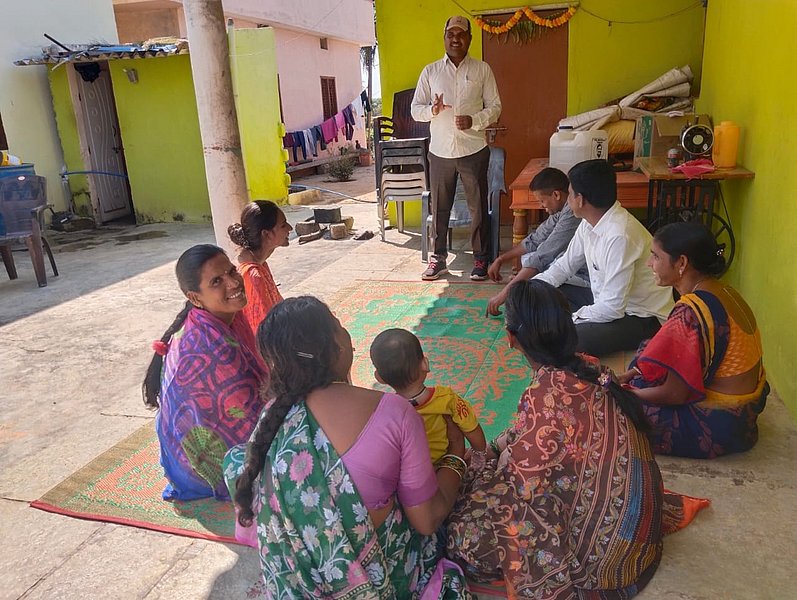
For six years, our partner BLESS in India has been helping more than 450 small farmers to increase their yields and thus significantly improve the food situation for the people. This is done, for example, through training, seeds, microloans or agricultural machinery. A method developed specifically for rice cultivation offers great advantages for the small farmers. And the environment also benefits greatly. Our regional representative for India, Dr. Judson Pothuraju, gives an introduction to this.
The soil in the central districts of the state of Telangana is very sandy. It rains little and the soil is not very fertile. The harvests of the small farmers living in the districts of Yadari Bhongir, Jangoan and Siddipeta are correspondingly meager. The poverty that results from this is evident in malnutrition, low education and a lack of prospects. Yet agriculture is the main source of income for 60 percent of the people. It therefore makes sense to support small farmers in order to sustainably improve their living conditions through higher yields.
The system of rice intensification
In 1983, the French Jesuit Henri de Laulanie developed a special method of rice cultivation in Madagascar. This method, known as rice intensification, promises higher yields at lower costs and also contributes to a natural balance in the environment. It is labor-intensive, but small farmers in particular benefit greatly from it. Nowadays, it is also used in Asia.
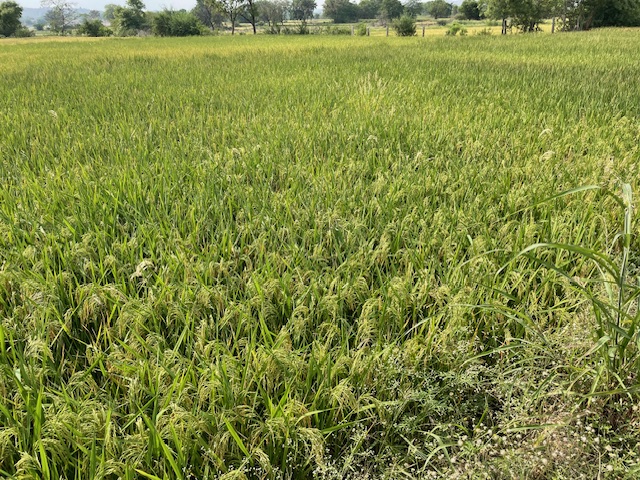
In conventional rice cultivation, many plants are planted close together in shallow water. In the dry state of Telangana, rice intensification can play a major advantage: the method uses much less water. The seedlings are planted earlier and over a larger area. The advantages are enormous:
- The amount of required seeds is only about 10-20% of the amount needed for conventional farming.
- The seedlings are planted very young – which saves time.
- Since the plants are planted individually, they form more stalks and a more robust root system. This leads to longer panicles and more grains.
- Chemical fertilizers and herbicides are not used. This promotes natural soil organisms.
- Weeds are worked into the soil by hand, acting as a natural, additional fertilizer.
- By planting in generous rows, the plants receive more sunlight, which means they produce more yield and pests are kept away.
People and the environment benefit enormously
However, the advantages for small farmers are not limited to the ecological benefits. The harvest increases by 20 to 50 percent. The costs are a quarter to a third lower than with conventional cultivation. The ripening time until harvest is one to three weeks shorter. Overall, the plants are more resistant to pests or environmental influences such as drought and cyclones due to this cultivation method.
The small farmers who use this method of rice intensification obtain a healthier staple food and generate a higher income from the sale of their products. The seeds obtained are of good quality and make it possible to cultivate the rice variety sustainably and permanently. Nature also benefits from the environmentally friendly cultivation – people live in a clean environment.
Scientific monitoring of the project
As a scientist – I am an entomologist and zoologist at Osmania University in Hyderabad – I find this project fascinating. Together with our partner BLESS, we were able to help small farmers in rural areas by providing them with knowledge, even though they are often unable to read or write. The implementation of the project was so important to some scientific institutes (Indian Institute of Rice Research, Central Research Institute for Dryland Agriculture, National Institute of Millet Research) that they accompanied it and used it for their research purposes. This experience was very special for the farmers: they experienced that science, unlike superstition, benefits them.
Holistic success
The small farmers harvest organic rice using the rice intensification method, without chemical residues. This contributes to the health of their families. The quality of the soil also improves with each passing year. I am delighted to see how this sustainable method and the transfer of knowledge are helping to improve the lives of small farmers on the fringes of society. It is a privilege for us as EBM INTERNATIONAL to be able to help shape these holistic successes.
By Dr. Judson Pothuraju, Regional Representative for India
This article was first published in EBMI-MAGAZIN 2/2024
Sow hope now – your donation for Thanksgiving
The food security projects in India are part of our Thanksgiving Campaign 2025: Together with you, we are fighting hunger, overcoming poverty, and preserving creation.