
India: A Safe Refuge for the Banjara Children
For the children of the Banjara people in southern India, the day often begins in the fields – amongst harvest baskets and farming tools – because there is no one else to look after them. Two small pre-schools run by our partner BLESS show how this can be changed: by providing a safe place, a warm meal – and the chance of a better future.
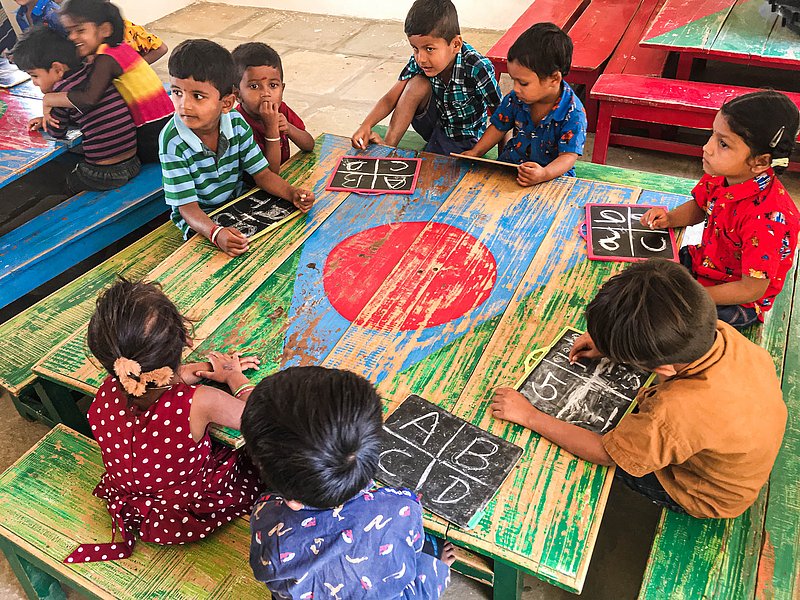
Shortly after nine o’clock in the morning, Gogulagutta Thanda falls silent. The adults are out in the fields, and the older children are at school. The younger girls and boys gather in a place set up especially for them: in this ‘Balwadi’, they learn numbers and the alphabet through singing, are later given a hot lunch, and are lovingly looked after and prepared for school. Things used to be different: back then, the youngest children would have spent the whole day in the fields – too young to understand what was happening around them, but old enough to hurt themselves in the process.
The Banjara – nomads who have settled down
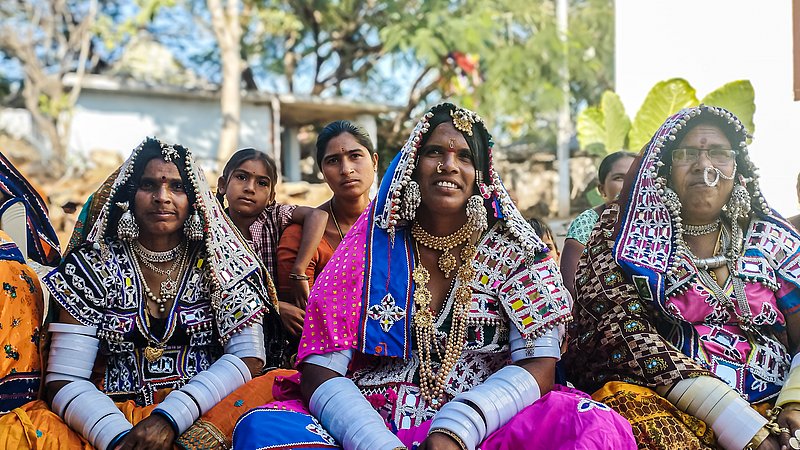
The people of Gogulagutta and the neighbouring Govindu Thanda belong to the Banjara community. Their ancestors once migrated from the Rajasthan region in northern India and travelled across the subcontinent as traders and cattle drovers. To this day, Banjara women can often be recognised by their colourful, richly embroidered clothing featuring mirror appliqués and beadwork. They wear heavy silver jewellery and ivory bracelets. Their dance, the Lambadi, is a reminder of their nomadic past – even though most Banjara families are now settled. They live in settlements comprising 30 to 100 families, known as thandas, often on stony, less fertile ground on the outskirts of larger villages. Their religious life is predominantly Hindu, with the saint Sevalal Maharaj as the central figure of their worship.
In 1976, the Banjara were officially recognised as a ‘Scheduled Tribe’ – which grants them a special constitutionally protected status: reserved places in educational institutions and the civil service, intended to compensate for their historically disadvantaged position. However, this recognition does little to change the economic reality on the ground: most families in Gogulagutta and Govindu Thanda make a living from farm work – either as day labourers or by working their own small plots of land.
When children have to go out into the fields
Where both parents go out to work in the fields, there is often no one to look after the youngest children. In many places, there is then only one solution: an older sibling takes the younger one out into the fields. For the little ones, this means long hours in the sun, near farming tools, without adult supervision. Accidents whilst playing are not uncommon. And with every year a child spends in this way instead of attending school, the risk grows that they will never properly start school at all – and will instead become child labourers themselves.
This is precisely where the work of BLESS comes in – the social welfare organisation of the South Lallaguda Baptist Church, which EBM INTERNATIONAL supports in the region.
Balwadis provide a safe environment and opportunities
In Gogulagutta and Govindu Thanda, BLESS runs two so-called balwadis – pre-schools for children under the age of five. Around 50 children now attend them regularly. From nine o’clock in the morning, they are in safe hands here: a teacher and a carer look after them while their parents are at work. The teacher is deliberately from the Banjara community herself – this ensures there are no language barriers.
The day is simply structured, yet has a lasting impact on the children: their first letters in Telugu and English, numbers, days of the week, months and rhymes. In between, there is outdoor exercise and play, and occasionally a short trip to the local area. At lunchtime, there is a nutritious, hot meal, regularly supplemented with vitamin supplements – for many children, this comprehensive care and support is by no means a given. Those who have attended the Balwadi pre-school then move on to the first year of the nearby primary school – generally much better prepared than children who were unable to follow this path.
Education for a better place in society
Sandhya Rani, a teacher at one of these pre-schools, attended the Balwadi in Gogulagutta Thanda herself as a little girl – in an environment where education, particularly for girls, was not highly valued. It was there, she explains, that the Balwadi sparked a passion within her: the desire to continue learning. On her own initiative and without external support, she continued her education – until she decided to become a teacher herself. Today, she stands before the next generation as a teacher: qualified, committed – and, as is well known in the village, particularly valued for her dedication.
As she puts it, she simply wanted to give something to the children who grow up “far away from civilisation” and help them secure a better place in society. Looking back, she says that the Balwadi transformed her from “a simple villager into a knowledgeable person”. Her wish for the next generation of her Banjara community is that they will one day be shaped by knowledge – and free from what Sandhya Rani calls “dark forces” that keep people in ignorance.

From Balwadi to the winners’ podium
Shaurya (name changed), also a former Balwadi pupil, has followed a remarkable path. Now aged 13, he is in Year 8 – and in 2025 he won gold medals in both national and international speed skating competitions. His talent was spotted at secondary school by his PE teacher, who has been providing him with targeted support and training ever since. Even though he has to take a step back from sport at the moment, his parents are very proud of their son’s international success.
A small place with a big impact
If you walk through Gogulagutta or Govindu Thanda today, you’ll come across quite a few young adults who once attended the Balwadi themselves – many of whom are now in training, in employment or, like Sandhya Rani, have returned directly to serve their own community. A simple act of service to the very youngest – a place of safety, a meal, a carer – yet one that means so much: the chance at a better life.
According to a report by Dr Judson Pothuraju, Regional Representative for India
This article was first published in the EBMI MAGAZINE 3/2026
God’s Peace for Children and Families
Preschools in India are part of our projects for “Children at Risk” initiative, which we are highlighting in our Christmas campaign. Through more than 50 projects worldwide, we work specifically to support children and young people: we create safe spaces, open up educational opportunities, and walk alongside families. We also share the story of Jesus Christ, in whom God’s transformative love has been made visible.
Your Christmas donation helps pave a path of peace for girls and boys!